Inheriting this “Enchanted Corner”
19 May 2026
Buongiorno ~
Following up on our promise to complete our 50th Anniversary report of last month, with the period beginning in 1990, it’s appropriate to acknowledge that while we remained a pioneer in the establishment of Virginia viticulture, after our first 15 years we were far from alone. And yet, it’s also true that it had not remotely been determined, what the best wines would be for these estates to pursue. One varietal planted in 1991 established immediately that it positively loves to grow here – Pinot Grigio, an early foundation of the romance we enjoy with Virginia, an augury of what would become a List of brilliant whites.

Well before 1990, one defining thing had certainly been shown, which drew me to Barboursville Vineyards in that year as winemaker/general manager. Its founder was determined to discover the answer to the question, what could we grow, to produce the finest wine we could extract, from what he called, “this enchanted corner” of Virginia. Thomas Jefferson’s hallmark Octagon — the core of the mansion he designed for Governor Barbour.

To this day, this aspiration animates every row of vines we grow. It’s inextinguishable by any trophy or praise. Now we have seen vintages of Cabernet Sauvignon (twice), Cabernet Franc, a Bordeaux blend, a true Passito of Moscato and Vidal, and Vermentino accorded the highest honors in Virginia, Gold Medals across America, and mid-90s ratings from the world’s leading critics. But who knows how gorgeous this year’s vintage will be? Viticulturist Fernando Franco, admiring a harvest’s Nebbiolo cluster.
A series of highly gratifying breakthroughs in the quality of our wines began, in the earliest 1990s, with our determination to apply the most promising techniques to every critical factor of vine vigor, from original selection of plant materials to soils preparation and site selection, to vine spacing, to trellising, to pruning, to cluster limitation, to canopy control, to timeliness of harvest – weather permitting. Viognier on the eve of harvesting.

Virginia’s reputation for growing season volatility is well deserved, so we knew we must adopt planting and vine management methods which were both aggressive in their optimization of site selection and preparation, and as adaptable as possible to diverse weather patterns. This fluency depends on an established, loyal, expertly experienced team of annually returning custodians of our vines. Our technical choices are therefore inherently more opportunistic than simply protective. Time and again, we have found that investment in technique has leveraged harvests to the outstanding category in which they might only be seen as acceptable – 1999, for example, 2006. When the weather elects to be fair, we are ready for it. Longtime, much-respected vineyard worker of past years, Epimenio in rows of our vines.


By the middle ’90s, we had amassed the necessary critical mass of data in our technical refinements, to expand the acreage planted in vine by more than 50 percent, both in new acreage and in replacement of one varietal by another, such as the installation of 3 different Bordeaux strains of Cabernet Franc beneath the slopes of the outdoor tasting terraces at the winery. Then did we turn to the jewel of the landscape, Goodlow Mountain — now designated, Goodlow Vineyard. Fernando Franco and I on Goodlow Mountain.
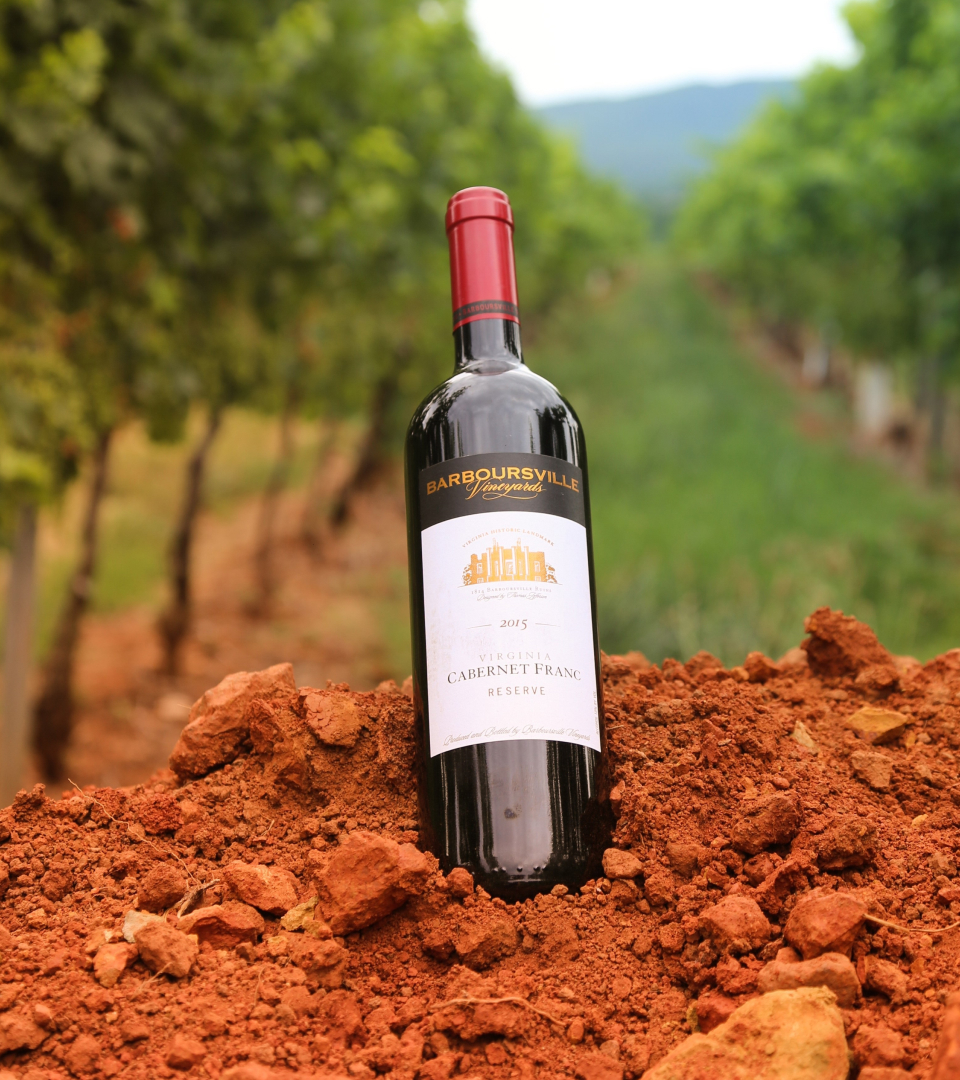
The great divide in the history of this estate will always be marked as the growing season given to us following the disastrously drenching year of 1996. 1997 proved to be a distinctly pivotal year for the region, itself, by revealing conclusively the adaptability of one of the noblest and most seductive of red wine varietals, to the soils and climate of Virginia. Everyone remembers the 1997 Cabernet Franc as a wine truly befitting what I then described as “the vintage of the century.” (Never mind, for the moment, how everyone but the judges – and ourselves – missed how close our Viognier Reserve came to stealing the Governor’s Cup from this same Cabernet Franc, in 1999). Two great vintages, 1997 and 1998, were our last in Cabernet Franc to wear the original label, the last not to be designated Reserve.


Cabernet Franc 1997 answered the call for an East Coast vitis vinifera red wine of international stature, and – sure enough – found its way to the Enoteca Trimani in Rome, as well as to respectful notice in Robert Parker. I have never witnessed such amazement paid to any Governor’s Cup wine – and we have seen 4 more Cups – as the widespread elation among winegrowers, which welcomed the real news of this particular wine. Virginia had found its legs.
Our most recent Governor’s Cup, Vermentino Reserve 2023.
By 1998, our estate had arrived at two crucial staffing enhancements. With the great surge of interest in our wines, led by Cabernet Franc, and aided materially by strong market appeal in Pinot Grigio and Philéo, since 1998 we have retained a full time expert in viticulture, in Fernando Franco, our widely honored authority in vine management, and invaluable recruiter-retainer of devoted seasonal vineyard workers. Further, given the environment of greater demand now for all our wines, we created the position of Associate Winemaker at the same time, with Daniele Tessaro holding this crucial position in winery management since 2008. Bringing in a bright harvest, with Fernando Franco (L) and Daniele Tessaro (R).


Had we done it? Had we found our best? As we took time to remind ourselves in a recent Note, our history of great vintages sometimes falls into clusters of three in a row.
With 1998 I found myself even more bullish with our harvest than in 1997, and built a cabinet of red wine Reserves — from Barbera to Sangiovese to Nebbiolo, and on to Cabernet Sauvignon — which swept all the reviews and juries they encountered.

1998 also gave us our third bottling of a Bordeaux blend I had designed initially as an almost private commemoration of our 20th Anniversary, in 1996, based on select barrels of Merlot, Cabernet Franc, and Cabernet Sauvignon.
Thus, Octagon Third Edition arose from this second superior vintage in a row, 1998. In 2002, England’s late dean of wine criticism, Michael Broadbent, hailed it from the pages of Decanter as “seriously good.” More than that it was admired, it was being watched.

Nine years off the vine, the 1998 Cabernet Sauvignon Reserve won the Virginia Governor’s Cup of 2007, having already been seen as the Secretariat of Virginia wine — and he’d had the good luck to retire as a 3 year old. In 2000, this wine caught the front page attention of the Washington Bureau Chief of The New York Times – R.W.Apple, Jr – an internationally popular culinary critic and mover and shaker of news from America’s political summit. Naturally focusing his full page article on Jefferson’s inspiration, he famously announced that his wish had been granted, for a decent bottle of Virginia wine.Being ready: Cabernet Sauvignon in October.


Did somebody say, “Nebbiolo”? Our experience with this varietal, even more than with our 5th Governor’s Cup winner, Passito, engages my Piemontese origins and reverence with special energy. All of our followers certainly know this, and I’m glad for their permission. Planted in 1995, our first Nebbiolo Reserve bore the vintage 1998, which became the only Nebbiolo in its year of the San Francisco International to win a Gold Medal. Our Nebbiolo has won that Gold Medal again, among several others in California competitions, and much cheerful astonishment from critics who consistently assess it in the mid-90s or better. Decanting Nebbiolo in the Barrel Room.
Even so, as late as 2007, Travel & Leisure’s esteemed critic, Bruce Schoenfeld, arrived here with the conviction that one cannot credibly grow Nebbiolo in Virginia. By the time he departed, he confessed his error, in very good humor in print. The happiest data point, perhaps, could be that our 50th Anniversary bottling of Octagon, boasts an infusion of 25 percent of volume, by Nebbiolo. An Autumn stay at The 1804 Inn, shown here, or in one of the nearby cottages, can enhance the exploration of any of our carefully cellared vintages with the most natural perspective.

For us, 1999 furnished a growing season justifying compare with the previous two, and compelled us to renounce delay in launching a Reserve in Cabernet Franc. This larger commitment of capital, manpower, and time before vintage release had been abundantly earned by the two preceding vintages, and by the varietal’s identifiably luminous contribution to Octagon – which Michael Broadbent had written, shone through. Now this recognition was being augmented by guarding its stature as an essentially stand-alone varietal worthy of the strongest development. We launched the most aggressive review of clonal selection and related cultivating choices we have ever pursued, with viticulturist Fernando Franco visiting Bordeaux, and hosting soils and vine experts from Bordeaux, consulting here.

Reaching this watershed, have we done it? Have we found our best? There’s still much proof that it’s too early to say. We’ve identified superbly adaptable warm climate whites, from the Rhône Valley’s Viognier, to Sardinia’s Vermentino, to Campania’s Fiano. We’ve created one of the most beautiful white wines to bear a Virginia label, Nascent, a unique blend of Viognier, Vermentino, and Falanghina. The first two of these varietals alone continue to lead our awards, with Vermentino accounting for the most unapproachable record in all the years of the Virginia Governor’s Cup — a Cup of its own, and 8 times selected among the Case of Top 12. The only wine that comes close in longevity of distinction is another beautiful blended white, Passito. That said, 2025 saw Nascent 2020 named by James Suckling among the Top 100 American wines of the year.

The competitions and the critics can assess only what we’ve done. We all recall how one critic for Decanter named Octagon 2017 among the Top 50 American wines tasted in 2025, and one of his colleagues named it as one of the Top 25 Merlot-based wines of the world. But to celebrate our historic commitment to discovery, for our Anniversary Octagon we naturally turned to something never attempted, never known, and never categorized before. Longtime followers of our wines – the best historians of this wine region – are certainly aware that for more than 25 years, Octagon has been our most durable platform for red wine development.


With our first Octagon, created to commemorate our 20th anniversary in 1996, Cabernet Franc 1997 and the full cohort of Reserve Reds of 1998 in hand, it became crucial to create a restaurant to match, to inspire, and to exhibit our wines to critics and loyal visitors alike. The contribution of Palladio Restaurant to the delight of our visitors is a happy point of pride, but it is for the kitchen’s wonderful manners – toward the ingredients and the palate alike – that I will always acknowledge the winemaking virtues of that gorgeous place. We’re grateful for Octagon’s placement on many fine wine lists of America, and for the rapport of Chef Michael Clough and Palladio’s kitchen with every one of its vintages.
Even as Palladio was opening its sunny Veranda dining room in 1999, it became very clear that we must annually lay aside a sizable reserve of fine vintages for visitors who can’t stay to dine, to rebut an intractable popular doubt, that these certainly are wines of extended age worthiness. Now, our western-horizoned Library 1821 has become an indispensable tasting anchor for any serious study of Virginia wine. The Library welcomes groups for tastings, as well as only one or two.

With that constantly growing “database” of superior vintages to explore, in flights or singly, and with some of the most beautiful dining to be enjoyed anywhere in Virginia, our historic dwellings were then renovated in the early 2000’s to the highest standard of charm and comfort, from lavish suites to jewel-like cottages. We had already presented William Shakespeare, at Jefferson’s Barbour Ruins every Summer, since 1990 with a raucously popular festival staged by the Four County Players. A decent bed and bite to eat seemed only fair.

Who could not be grateful for this foundation, and for the opportunity to have contributed to it? It would be idle to dream of matching the estate’s diversity of attainment in those 50 years, but our new generation doesn’t have to try. That vision is extravagantly in place all around us, and is yours to share on any visit. What we must do with this inheritance, however, is no small thing. We must answer for why we’re here, with the best wine that’s in this privileged ground’s embrace. It’s great to know, you hope for the same.
Cordialmente ~
Luca Paschina Winemaker


